Twenty years of financial education. The number hasn’t moved.
The Decimal Currency Board had a mascot. Dickie Decimal, a cartoon coin with a face, deployed across conversion charts and public information films to make a new currency feel familiar before it arrived on 15 February 1971.
It didn’t work. And the reason it didn’t work is still running inside every financial education programme in Britain today.
The preparation wasn’t lazy. Halsbury recommended decimalisation in 1963, the Act passed in 1967, and the Board spent years on a well-funded campaign. The arithmetic was never hard.
What went wrong was the order of operations. The change was decided, then delivered, then explained — and only the last of those three involved anyone who actually had to use the thing. A woman who’d priced a Manchester market stall in shillings for thirty years got a pamphlet on a Monday morning and the assumption that comprehension follows exposure.
Fifty-five years on, that sequence hasn’t changed. Ask anyone whose accounting software added an AI forecasting feature last year without telling them what it was doing.
Who was this built for?
Here’s the question the financial inclusion sector rarely asks. Not why people fail to understand money — who was financial education designed to serve?
Not them.
The Trustee Savings Bank ran savings schemes in British primary schools for most of the twentieth century. A child brought in a few pennies a week, a teacher wrote it in a passbook. What was being taught was habit rather than arithmetic: deposit regularly, don’t touch it. With a quieter lesson underneath about trusting whoever holds the book.
Fine for a seven-year-old. It produced generations of dependable savers. It was also a curriculum built around what makes a good customer, not what makes someone able to judge whether the rate they’re offered is any good.
That wasn’t a conspiracy. Banks existed to allocate capital efficiently, efficiency needed customers who behaved predictably, and predictability needed you to understand the product — not the system the product sat inside.
The model survived nationalisation and the postwar credit boom. It survived the Big Bang of 1986, then the internet, without anyone revisiting the premise. When FinTech arrived talking about democratisation, it walked into an educational landscape nobody had redesigned, and found a fresh set of products not to explain.
The register problem
Financial education in this country is almost always offered as a correction.
Targeted at people identified as lacking something. Described in the language of gaps and vulnerability. Delivered with an implicit message the curriculum never says out loud: you’re here because something went wrong.
The targeting is usually accurate. The framing comes along with it anyway.
Nobody aspires to remediation.
A small thing that gives the game away: the phrase “financial capability.” I’ve never heard a business owner use it about themselves. It’s a term the sector uses about other people, which tells you most of what you need to know about who it was written for.
What the sector published about itself
In September 2025 the London Foundation for Banking & Finance published, with Bayes Business School, the most thorough independent review of UK financial literacy provision in a decade.
Accelerating Progress: Financial Capability in the UK is an unusually candid document. Its central finding is that effective interventions from reputable providers aren’t shifting the numbers — individually or together — at anything close to the pace required. It records literacy gaps reaching 45% where demographic factors intersect, and recommends that tailoring provision to individual circumstances matters as much as scaling it.
Two decades of investment. Competent programmes, professionally delivered, by organisations with no cynical motive whatsoever.
And the Money and Pensions Service still finds 39% of UK adults — 20.3 million people — saying they don’t feel confident managing their own money.
If the content were the problem, that number would have moved.
What works, and why almost nobody copies it
M-Pesa never ran a financial literacy programme.
Safaricom launched it in Kenya in 2007 by starting from a narrower question than the education sector asks: what do people need to do with money, given the constraints they live under? Send it to each other, safely, without a bank account. The interface mirrored behaviour users already understood from informal transfers. The agent network — small shops and kiosks acting as human access points — supplied the translation layer.
Formal financial inclusion in Kenya went from 26.7% in 2006 to 82.9% by 2019.
Nobody completed a module first. The learning sat inside the thing being used.
Nobody’s suggesting we import a Kenyan mobile money system into the West Midlands. The point is narrower: the design principle has been proven at national scale, and adopting it costs very little beyond a willingness to stop leading with deficit.
If you’re running a business, this is your problem too
The remedial frame isn’t only a policy failure. It’s the reason most competent owners have never seriously invested in their own financial fluency — they’ve only ever been offered it as catch-up, and turning that down is a rational response to a bad offer.
Meanwhile the ground moves. DSIT research puts deliberate AI adoption among UK small businesses at roughly 16%. Ask instead how many are using AI at all — inside the accounting software, the payments platform, the CRM that added a scoring feature in a release note nobody read — and it’s nearer 70%.
Most owners running AI-assisted businesses have no idea that’s what they’re doing. It’s the 1971 pattern again, at higher speed and with better graphics.
One number for scale, and it’s worth being precise about what it covers: FutureDotNow, working from Lloyds’ Essential Digital Skills research, puts the annual value of closing the UK workforce’s digital skills gap at around £23 billion. That measures a specific thing — whether working adults can perform twenty tasks designated as essential. Financial comprehension overlaps with that and isn’t the same gap. Using a supplier portal is some distance from understanding what your merchant statement charges you, or why a lender’s model scored you the way it did. Nobody has costed the second one.
The fix is free
Change the register and the response changes. Offer financial fluency as something capable, ambitious people already have — rather than the correction for people who’ve fallen behind — and uptake changes. So does retention, and what people do with the knowledge afterwards.
I’ve watched that happen repeatedly across the businesses I work with at Vogue Boost. That’s practitioner evidence rather than a controlled trial, and I’d rather label it that way than dress it up.
The design principle has been sitting in the sector’s own literature for a year. Rewriting the offer costs almost nothing. That it hasn’t been rewritten tells you who the field still thinks it’s talking to — and the answer hasn’t changed since the passbook.
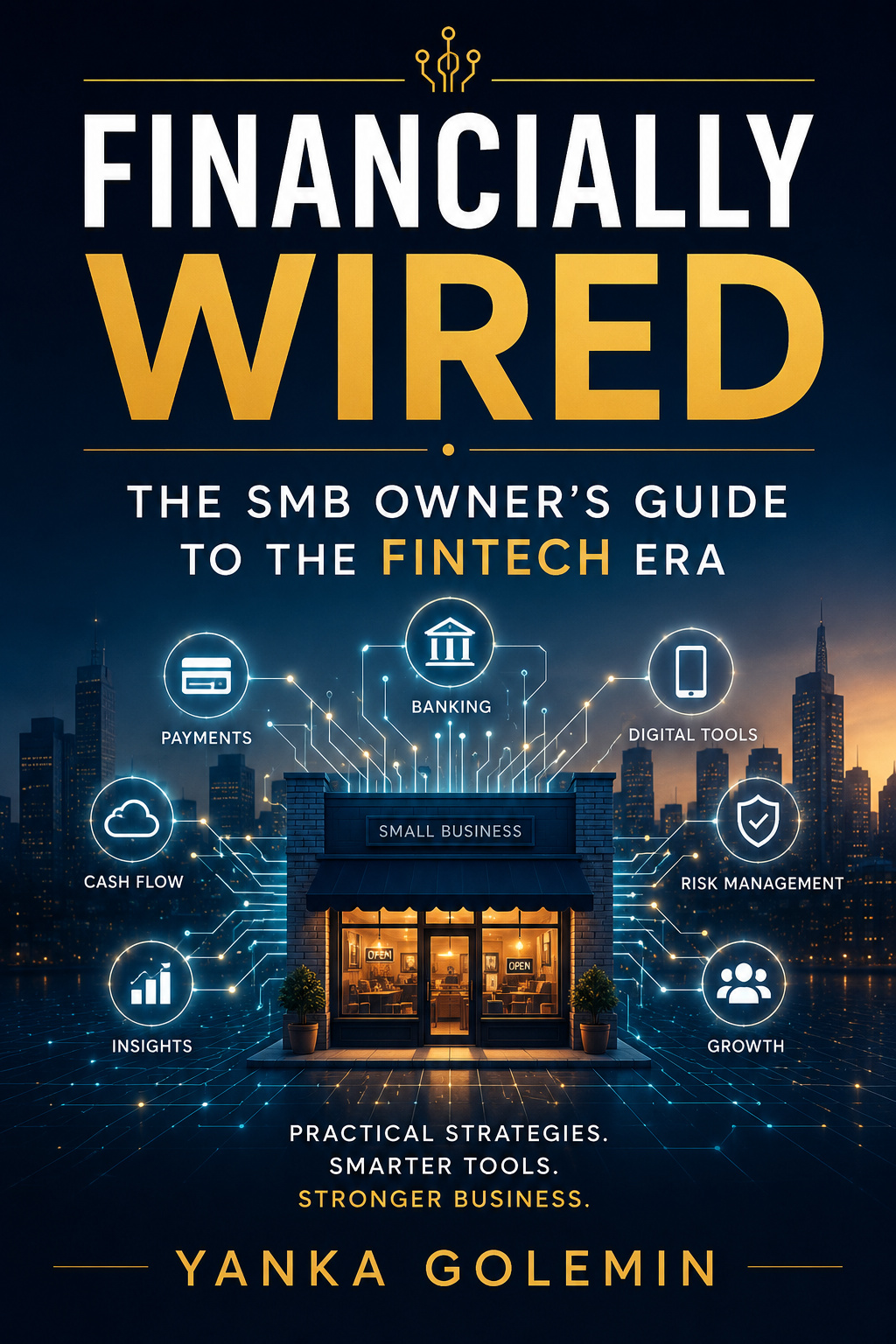
This argument runs through Financially Wired: The SMB Owner’s Guide to the FinTech Era, out now on Amazon: https://www.amazon.com/dp/B0HHDHV73C
#SMBfinance #FinTech #FinancialLiteracy